
by Amy Antonation
The multiverse has been a pop-culture staple for decades now, but to most Americans, the concept applies only to Chinese-American laundromats, superheroes, and the occasional world behind the wardrobe door. The idea of your vodka coming from a sort of parallel universe—where the laws of distillation as well as nature differ strikingly from the expected—isn’t quite as well established. But if New Zealand’s Broken Shed Vodka has its way, drinkers across the United States will soon be familiar with their product, which hails from a land of bizarre creatures and, fittingly, is made with some unusual ingredients. It is, as the brand likes to say, vodka from a different world.
In any reality, starting with solid basics is critical. And in the production of vodka, you don’t get more basic than water, which comprises 60% of each Broken Shed expression—so the brand goes above and beyond to obtain its main ingredient, using two different sources. In addition to filtered spring water from New Zealand’s North Island, “the water from the South Island comes from an ancient aquifer,” says Jean-Marie Heins, Broken Shed’s chief marketing officer. “It’s unique to us. It’s a mineral water, and we leave the minerals in there.” The brand’s founders dubbed it “tasty water,” she adds, noting that it provides “width on the palate and sweetness.” While its exact mineral content and its percentage in the final blend is proprietary, Heins characterizes its impact on the final product by saying, “Our vodka is often attributed as having a rounded sweetness . . . so that one doesn’t get the common ethanol edge that is present in many vodkas. It is that alchemy that creates Broken Shed.”

But even the most delicious, bespoke water can’t be magically transformed into vodka alone. Enter the most surprising ingredient that goes into Broken Shed: whey. Distilling this natural byproduct of New Zealand’s dairy industry is an elegant solution on both the quality and sustainability fronts: Historically, says Heins, much of it went unused, “but it’s got a lot of value to it.” In addition to diverting it from waterways and reducing pollution, Broken Shed’s use of whey in production means less farmland is cultivated for common vodka bases like grains, and since the whey it uses is already in liquid form, no water is added during distillation—all good things for the environment.
“‘[Whey] isn’t the easiest thing in the world to distill,” Heins admits: It contains fewer carbs than conventional bases and so requires a specific yeast during the process. But the resulting gluten- and GMO-free spirit is worth it. “Whey is very, very pure, and it distills super cleanly,” points out Heins, who says the triple-distilled product maintains abundant character, and its interaction with the mineral water results in real magic: “[While] the sweetness comes from the mineral water. I think whey gives [our vodka] the grassy notes and a certain amount of creaminess. The mouthfeel is one of the things that makes our vodka special: It has a clean taste with character and a lush mouthfeel. It dances around your mouth.” Broken Shed also eschews any and all additives (including the common addition of up to 2% citric acid), instead trusting in the quality of its unadulterated ingredients to entice customers.
That strategy has proven successful since the brand made its first foray into the U.S. market in 2018: For three consecutive years, it’s been the fastest-growing vodka in the country, according to the Liquor Handbook. It’s on track to sell 34,000 9-liter cases by the end of its fiscal year in March—a nearly 67% increase over the previous year. Stateside consumers can currently find the brand in 30 states, and thanks to its recent partnership with Southern Glazer’s Wine & Spirits, says Heins, “That’s going to start escalating in the next fiscal year as we’re adding markets.” Bottles of Broken Shed should be on shelves across the U.S. by the end of 2024.
Ahead of its expansion, Broken Shed debuted new marketing initiatives in October 2023. “We’re a different vodka,” Heins explains. “We’re made differently, and we come from a country you don’t expect vodka to come from, so we are highlighting New Zealand.” Their “Vodka From a Different World” campaign includes social media posts about the otherworldly landscapes of the island nation, home to a curious menagerie. Learn about the kereru, a pigeon with a penchant for consuming fruit that can, in warm weather, ferment inside the bird’s crop and cause it to tumble gracelessly out of trees under the influence of alcohol; the tuatara, a nocturnal, cold-loving, three-eyed reptile that’s the last surviving species of an order that existed alongside dinosaurs; and the kea, the world’s only alpine parrot, which is rumored to be as smart as a 4-year-old human.
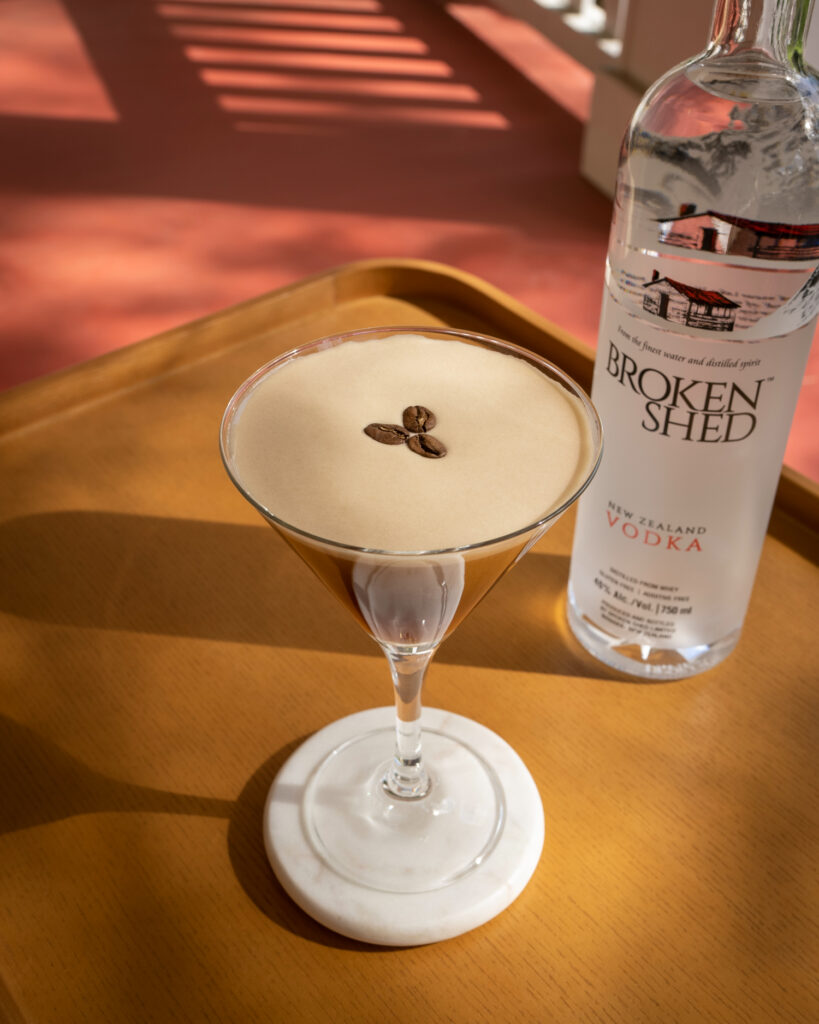
Given all of New Zealand’s natural wonders, the fact that it’s home to a vodka as unique as some of its native creatures comes as no surprise. “People are looking for something new,” says Heins. “People care about sustainability and they want to know they are eating and drinking things that are cleaner and don’t have a lot of additives. Not all vodka is the same. It can have differences, and those differences should be explored.”
