
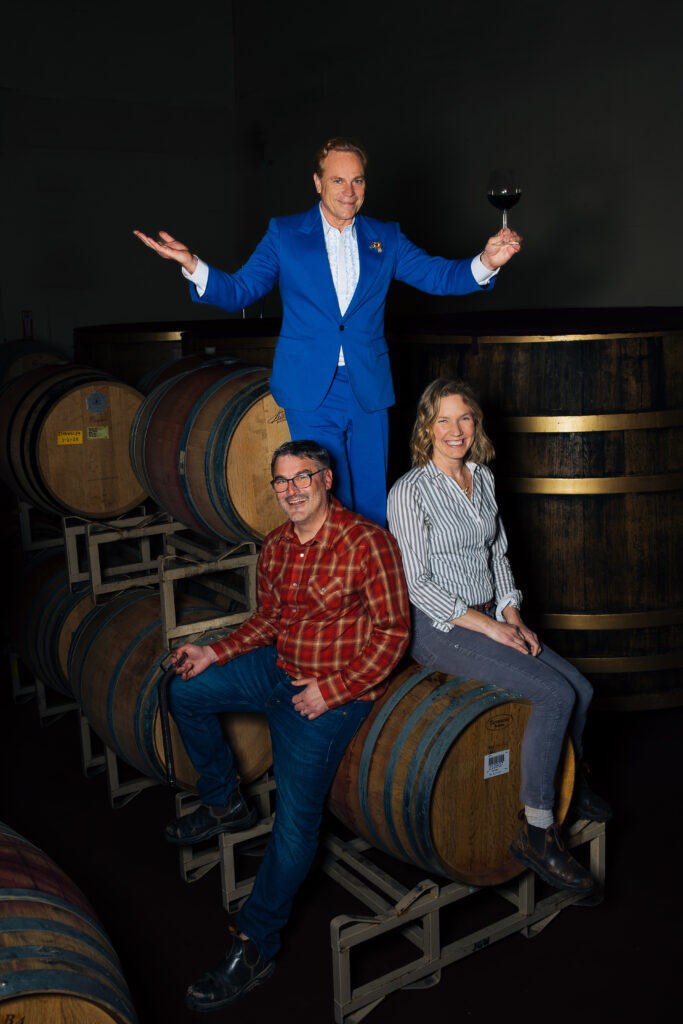
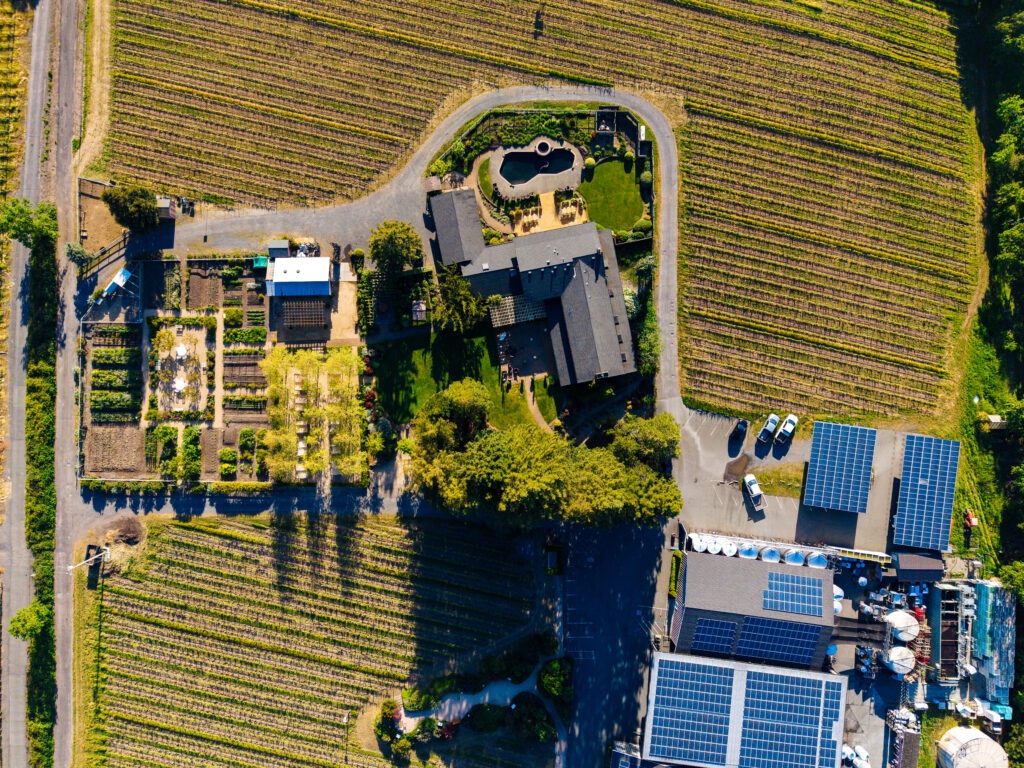
DeLoach Vineyards has been under the ownership of Jean-Charles Boisset since 2003, when the Burgundy-born vintner acquired the historic Russian River Valley estate with a vision for elevating its quality while embracing more sustainable methods of farming. The inaugural release under his auspices—the DeLoach 2004 30th Anniversary Cuvée Pinot Noir—made an immediate impact, earning a host of accolades. Meanwhile, the estate was undergoing a full transformation: The original vines dating to 1973 were pulled; the soils were revitalized through cover cropping; and a firm commitment was made to biodynamic viticulture and the development of strong relationships with growers, including several in Marin County.
At the core of this evolution is a rock-solid long-term winemaking team led by Brian Maloney and Katie Carter, who’ve helped shape DeLoach’s identity through their precise, terroir-driven lens. As DeLoach Vineyards celebrates its 50th harvest, the Russian River Valley stalwart is turning a meaningful corner. Beginning with the 2023 vintage, which will be available in early 2026, the winery is relaunching its Russian River Valley Pinot Noir and Chardonnay with a major upgrade: The wines are made with 100% organic grapes certified by California Certified Organic Farmers (CCOF), a significant portion of which came from the DeLoach Estate Vineyard. The 21-acre property, situated off Olivet Road in the heart of the Russian River Valley, includes 17 planted acres of vines, which received organic certification from CCOF in 2008 and Biodynamic certification from Demeter in 2009.
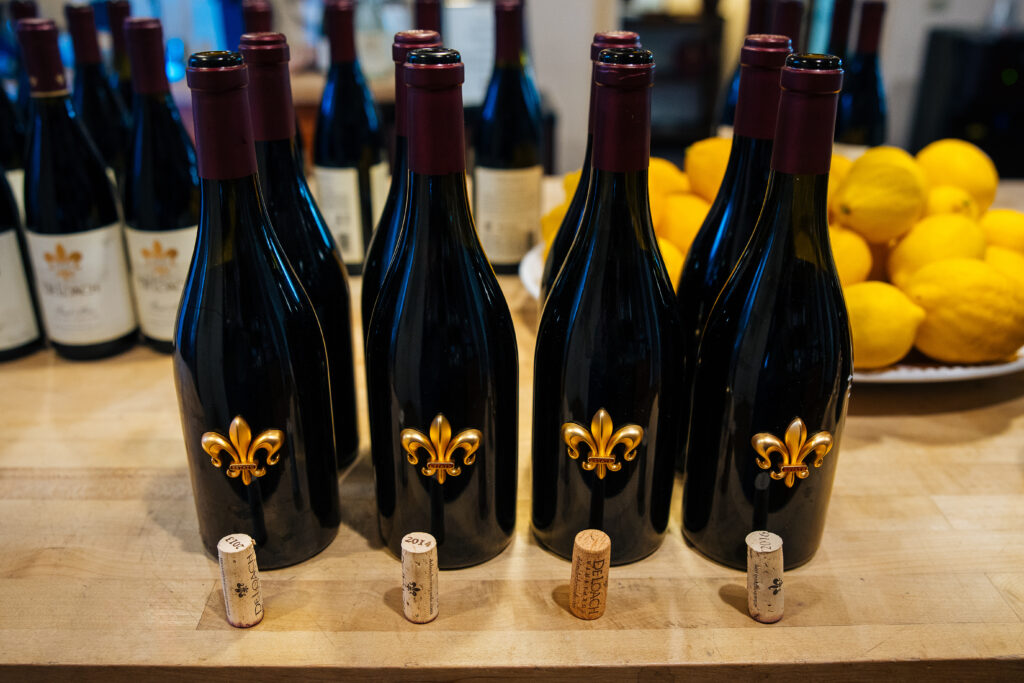
“For the wider consumer audience out there, we’re making some big changes in our production,” explains Maloney. “By blending in a large portion of certified-organic grapes from our DeLoach estate into our Russian River Valley wine, we’re elevating the experience of what has always been one of our more broadly distributed Pinots,” which will bear a “Made With Organic Grapes” label and be aimed at the on-premise market with a $50 SRP. The shift is part of a larger strategic vision, adds Carter: “We’re also relaunching our California tier. It’s certified sustainable by the California Sustainable Winegrowers Association and will feature new packaging that reflects the full story of what we’re doing here at DeLoach—from entry-level through to the Estate [collection].” Priced at $15, the California-appellated wines will debut in lightweight glass bottles with their new seal as of the 2024 vintage.
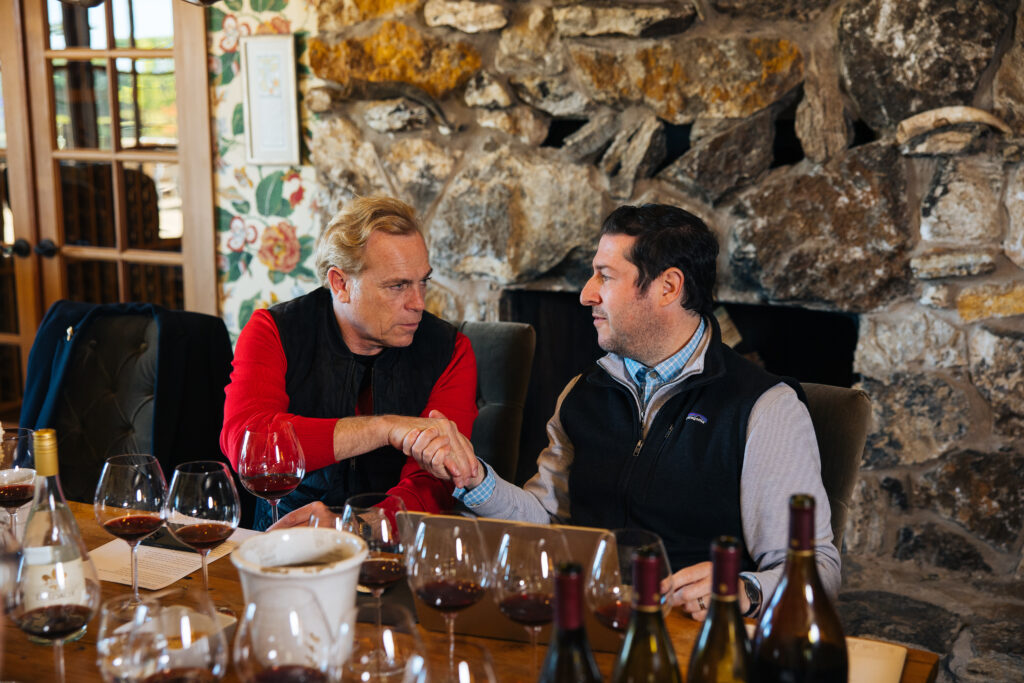
To underscore the consistency and ageability of their Russian River Valley Pinot Noirs, the winemaking team invited me to a vertical tasting of vintages from 2010 to 2022 (alongside a magnum of the 2004 30th Anniversary Cuvée). Showcasing their structure, savory depth, and impressive freshness, the experience confirmed the wines’ evolving finesse. I wanted to understand the secret sauce in their production, and what follows are some heady, if not downright geeky, insights into how—and why—DeLoach is positioning itself as a serious Russian River contender for decades to come.
Barrel Boost
One of the great hallmarks of the DeLoach Pinot Noirs is their beautiful integration of fine French oak, which contributes to the wines’ seductive, irresistibly elegant aromas and flavors and sturdy backbone of fine tannins while lending an air of restraint akin to the way a champion Greyhound carries itself—in a graceful, sleek, controlled, fine-boned manner, with a natural smoothness and balance.
“That oak influence is intentional,” said Maloney. “It’s meant to wrap the fruit in structure, give a little tension and lift the savory tones—tobacco, loam—while still letting the ripe fruit have its say.”
Maloney credits the winery’s ties to Burgundy through its ownership by the Boisset Collection. “We were able to get access to coopers like Tonnellerie Chassin in 2007 and 2008—long before others in California. That direct Burgundy pipeline changed our approach,” he said. Today, that oak is deployed with surgical precision across vineyard designates such as van der Kamp, Maboroshi, Masút, Annapolis Ridge, and Devil’s Gulch, to list a few. The guiding philosophy: “Oak usage should marry into the wine, as opposed to being the house signature of the wine,” added Maloney.
The DeLoach estate itself is divided into two key parcels. The rear section—dubbed Les Parcelles Cacheés, or “The Hidden Parcel”—has shallow soils just 18–24 inches deep, producing fruit that “ripens earlier [and] typically has more of a bright-red kind of raspberry fruit element,” Maloney explained. “I think it’s very pretty, very elegant. It can be easily overwhelmed by heavier toast, by more intense oak extraction. And so we look at a much lighter expression.” Coopers like Chassin pair well with fruit from the rear parcel, offering support without overtaking the wine.
By contrast, the front section, La Bienvenue, has 3 feet of topsoil and ripens a week to ten days later. Its grapes tend to show more richness and depth, and barrels from coopers like François Frères and Remond are matched accordingly. “There’s a little more sweetness and density to the fruit from those soils, and that marries better with the broader oak profile from those coopers,” said Maloney. Indeed, earlier vintages of DeLoach, from around 2008 to 2012, show more muscularity because they were sourced exclusively from this part of the vineyard; around 2014, as the vines from the rear section matured and were incorporated into the blend, the estate Pinot developed greater elegance.
When stems are ripe enough for whole-cluster inclusion, Maloney noted, new oak use drops dramatically. “Stems bring their own tannic support and aromatic lift,” he explained, pointing to the 2004 magnum of DeLoach’s 30th Anniversary Cuvée. Seeing 100% whole cluster and 0% new oak, the wine presented Earl Grey tea–like tannins and spice aromas in fascinating fashion.
Carter added, “We’re looking at the vintage and how the fruit comes in. Clones will express differently year to year depending on the vintage, especially if there’s whole cluster, and then we’re looking at either no new oak or just a kiss—it’s about marrying the final blend, it’s bringing a little bit of breadth, and it’s boosting a little bit of spice. It’s supporting the terroir in a way that doesn’t dominate as a signature.”
Clonal Complexity
Beyond soil depth and oak use, clone selection plays a significant role. The estate vineyard is a patchwork of clones, including 23, 115, 828, 777, Calera, La Tâche, Mt. Eden, and Swan.
“They’re ripening weeks apart, and each contributes differently to the final blend,” Carter explained. Clone 23, a Swiss selection with big clusters and berries, tends to broaden the palate without adding midpalate density. “It’s not usually a dominant clone for us,” she noted, “but more like a spice in the rack—used in small percentages to add dimension.”
“In the 2019 vintage, for example,” continued Maloney, “Clone 23 took a front seat in one blend for the first time. You really notice how it spreads the palate out horizontally. Then you compare it to something like Clone 828, which has this dark-fruited, taut line to it—much more vertical. It’s fascinating to see how these expressions interplay.”
Vintage variation determines how clones behave. “Hot? Cool? Long hang time? Disease pressure? All of it impacts how the fruit expresses during fermentation,” said Carter. “And then we assess for whole-cluster potential and oak integration from there.”
A Minimalist’s Mindset
Maloney and Carter are both vocal about their aversion to overt manipulation. “There are a lot of additions winemakers lean on—tannin, acid, and so on,” Maloney said. “But if you step back and let the natural processes unfold, you usually make better wine.”
He referred to acid as a common crutch—”especially if you were trained at [the University of California,] Davis, where chemistry dominates. But grapevines have natural metabolic pathways that acidify wine if you just let them run their course.” Succinic acid, for example, is produced by yeast during healthy ferments, adding natural acidity. “The key is correct fermentation kinetics,” he asserted. “You get a balanced wine just by creating a healthy microbial environment.”
“It might sound like we’re just being farmers ignoring lab results,” Maloney said with a laugh, but “I still look at lab results and run projections. But what’s exciting is when something surprising and delicious happens because of the native ferments we use. . . . I just let the vines and microbes lead the way when they can.”
This scientific-meets-sensory approach has guided DeLoach since the estate became certified organic by the CCOF 17 years ago. A renewed focus on vine health, canopy management, and minimal intervention has defined the past decade.
By the end of our interview, Maloney was growing naturally excited, almost as if some spontaneous fermentation were occurring within him. Maybe it was the kinetic energy of Jean-Charles Boisset himself, who had spent an hour touring the property with the winemakers and me prior to our tasting; maybe it was that 2004 DeLoach in his glass, or maybe it was the more current vintages—or the imminent release of the 2023 Russian River Pinot and Chardonnay with their “Made With Organic Grapes” label.
Regardless, it’s clear that DeLoach’s next chapter will be centered on the connections between history, terroir, and science, and both Maloney and Carter keep up on all the latest efforts occurring within the latter realm. Maloney lit up when discussing recent UC Davis research into native versus inoculated yeast strains, commenting, “They found a hybrid yeast at a neighboring winery—a cross between European wine yeast and a native Pacific Coast strain. It was doing nearly all the fermentation. Now we’re investigating whether something similar is happening in our own cellar.” If confirmed, the implications are huge. “If you’re doing native fermentations, the dominant yeast should be everywhere, not just hiding in some barrel,” he pointed out. “It’s a whole new layer of discovery.”
