story by Allyson Reedy / photos by Jeremy Ball
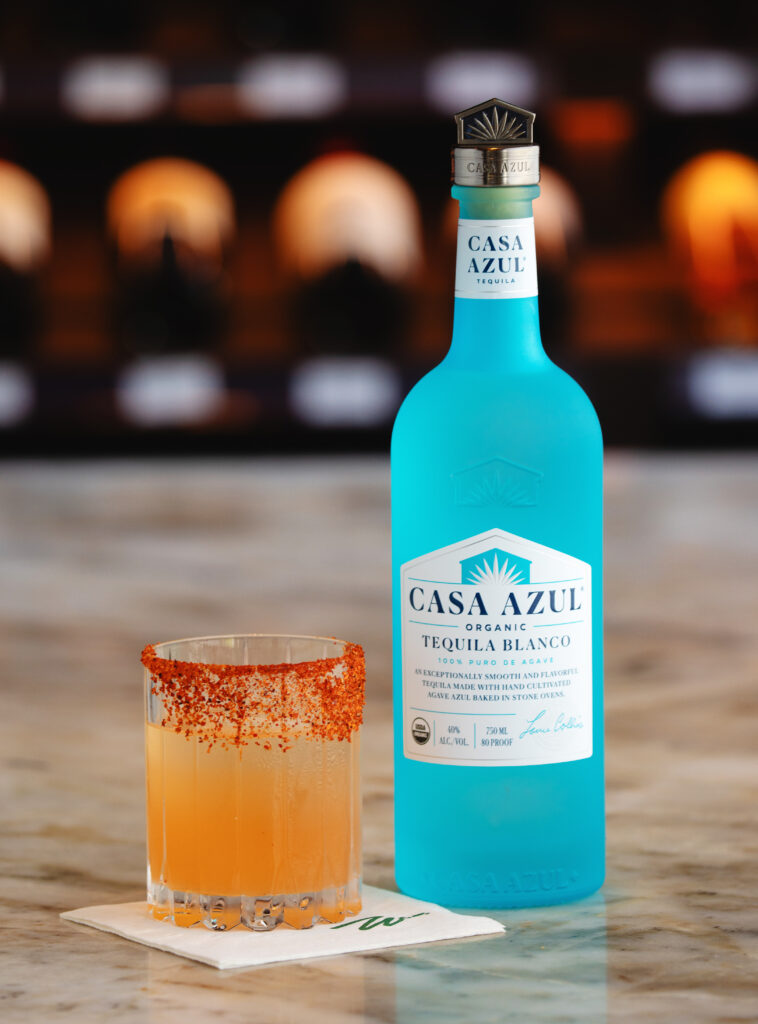
Melding Casa Azul Blanco with Aperol, Fresno chile, and Damiana liqueur in a glass rimmed with Tajín, the Eiza “turned into a phenomenon . . . and [has] just excelled” at the three Wally’s locations in Beverly Hills, Santa Monica, and Las Vegas, Fay notes.
“Given how much we put into taking care of the agave plants, our whole brand is based around showing off that incredible character,” Carr says of Casa Azul’s plant-first philosophy. “Plant-based” and“plant-forward” are buzzwords right now in the culinary world, but at Casa Azul, putting the plant—namely the large, spiky Blue Weber agaves that grow in the lowlands of Jalisco—first isn’t a trend so much as a philosophy. “We’re committed to crafting tequila the right way, not the easy way,” says Casa Azul CEO Dennis Carr. “Our philosophy is that the best tequila can only be made using the finest agave.”
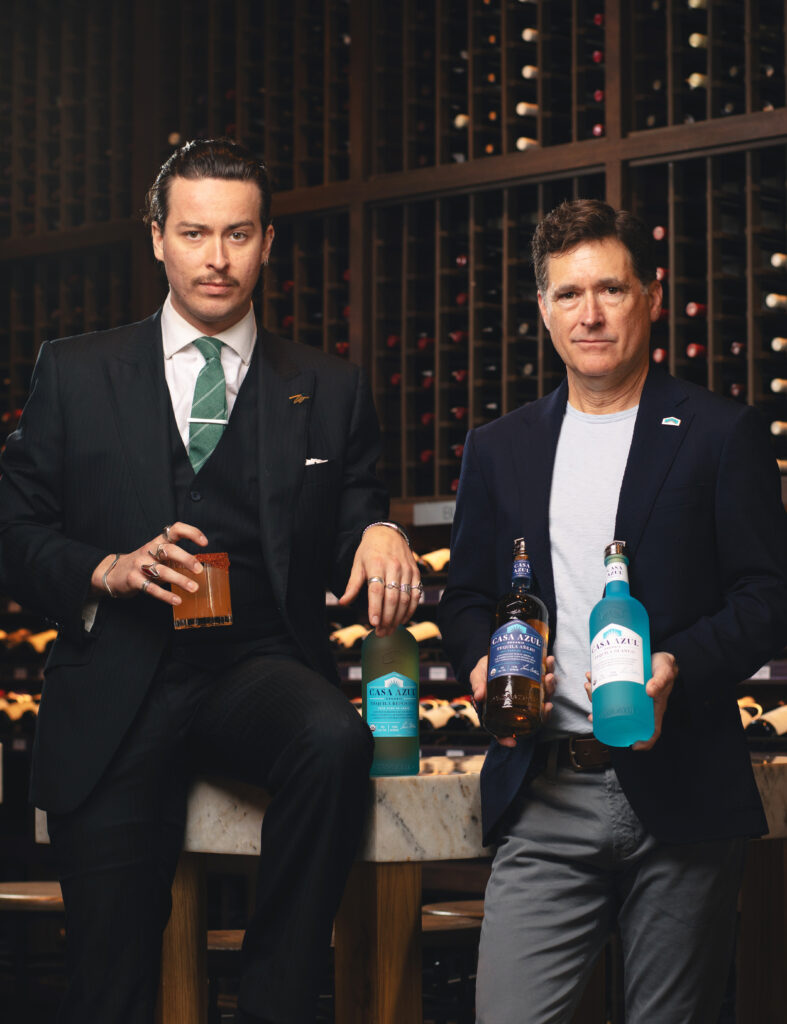
When founders Lance and Linda Collins set out to create the brand, then, they knew they first had to team up with the right partners. They spent two years searching Jalisco before they found the Montes family, who have farmed agave for three generations in addition to being master distillers working out of a USDA-certified organic facility. “To make the most high-quality tequila, we needed to go to the source—not just another distillery but the farm that feeds it. Our ethos of creating better-for-you products and doing things the right way is the genesis of Casa Azul,” Lance, who also serves as brand chairman, told The Tasting Panel last year.
Everything indeed starts at the Montes’ farm, where they tend to the land and its dark, mineral-rich volcanic soils entirely by hand. They have been farming agave since 1935, when Alvaro Montes Contreras coaxed a tough, barren plot into becoming one of the premier agave farms in the area. “They really want to take care of that land that has taken care of them,” Carr says of the Montes family, who now grow all their agave plants within 50 kilometers of the distillery. “They’re still on that same plot of land, although they’ve grown a bit beyond it.”
Casa Azul launched its organic Blanco, Reposado, and Añejo tequilas in 2023. (Carr says an Extra Añejo is in the works, but there’s no timeline on when it’ll be available.) The Blanco ($69) rests for two to three months in stainless-steel tanks before bottling, developing vibrant agave flavors; hints of herbs and minerals; and a soft, smooth profile. Its frosted blue glass bottle was an instant hit with consumers, and it’s no wonder why—the eye-catching aqua hue looks beautiful on the bar and shelf.
Packaged in the same handsome bottle, the Reposado is aged in American oak barrels previously used to mature bourbon, but “the oak regimen we implement in both the Repo and Añejo is not meant to overwhelm the agave,” Carr says. “Given how much we put into taking care of the agave plants, our whole brand is based around showing off that incredible character.” The Reposado ($89) spends four to six months in cask, a process that yields an exceptionally smooth finish plus hints of toffee and caramel to highlight those rich, baked agave flavors. Bottled in 100% recycled, blue-tinted glass, the Añejo ($129), for its part, rests for over 15 months in the barrels, resulting in a deeply layered profile of dark chocolate, cracked pepper, and toasted oak.
But before the spirits can achieve this level of quality, the agave plants must first be nurtured to full maturity, which tends to take six to eight years. This promotes optimal sugar development, which translates to greater complexity in the finished tequilas. “The key is patience to let the plant finish its natural journey,” Carr says. “We don’t harvest early to save money.”
Given all the time and effort that go into growing mature agave, it’d be a shame to dilute the beautiful flavors that result with additives such as the chemical fermentation accelerants, caramel coloring, and vanilla flavoring that many distilleries rely on. And so Casa Azul uses just three total ingredients in its tequila: single estate–grown Blue Weber agave, wild yeast, and water from a deep natural well on the Montes land. The distilling process is led by master distiller Eladio Montes Jr., following the same meticulous standards as the farming; to begin, the agave piñas are roasted low and slow in a traditional stone oven for two to three days to soften the plant fibers without excessively caramelizing them. Wild-yeast fermentation takes another three to four days, which is well worth the time given the enhanced aromas and full body this process contributes. The spirit is then twice-distilled in pot stills before the aforementioned resting process. “I’ve been very successful in knowing when the consumer is ready for something better, and Casa Azul wants to welcome more drinkers to a serious craft product,” Collins says of why they go the extra mile.
It’s not just everyday consumers who have become fans of Casa Azul’s organic tequilas: Celebrities are invested—and literally investing—in Casa Azul rather than simply being paid to drink the products and post about it on their social media accounts. Mexican-born actress Eiza González and Kansas City Chiefs tight end Travis Kelce are both big-name investors, as are professional golfers Michelle Wie West, Brooks Koepka, and Bryson DeChambeau.
That said, Carr insists that “we don’t consider ourselves a celebrity brand. What’s different about us is that we’re a lifestyle brand that attracts the interest of celebrities. They like to enjoy the product and they want to invest.” So if, say, Kelce posts the blue bottle on his Instagram or TikTok, the additional exposure is just a bonus.
Prominent bartenders are loving Casa Azul, too, like Brando Fay, the Beverly Hills, California–based senior mixologist at Wally’s Wine & Spirits. When he first took over the beverage program and needed to create a house Margarita, he went straight for Casa Azul “because of how innovative in the industry they are,” Fay says. “It’s just a fantastic brand, and it showcases all the best qualities of tequila.” That Margarita, named the Eiza in honor of González, is now one of the most popular drinks at Wally’s, not only in Beverly Hills but also at the other two Wally’s locations in Santa Monica and Las Vegas; melding the Casa Azul Blanco with Aperol, Fresno chile, and an herbaceous Mexican liqueur named Damiana in a glass rimmed with Tajín, “it turned into a phenomenon . . . at all three locations and [has] just excelled,” so much so that it’ll soon be on tap in order to better meet demand, notes Fay. “I personally have a very strong opinion toward [spirits being] organic and certified [and] having that very important understanding of where [a product] came from [and if] the distillers are taken care of and . . . the farm [is] giving back to nature. Working with Casa Azul is a no-brainer [in that respect], and [the Eiza] has turned out to be one of our bestselling cocktails here because it’s so approachable. . . . I wanted to make sure everyone could enjoy such an amazing tequila.”
While the cocktail is an undeniable hit, Fay says people are ordering the tequilas straight too, especially 2-ounce pours of the Reposado and Añejo. “We can’t even keep it on our shelves, it’s that popular. It really hits all the demographics—the cocktail [lovers] with the Blanco and the Reposado and Añejo for the slow sippers,” he says. No matter how they drink it, though, those customers can surely taste the agave’s caramelly sweetness, citrus character, and earthy undertones—all evidence of Casa Azul’s plant-first philosophy—in every sip.